Essaouira

The pure white houses that often reflect in the blue sea and the blue sky are colored with colorful carpets and pottery, a French-style castle, an Arab-style mosque, a West African-style residence exotically produces the city. The beautiful harbor city that Moroccans choose for their honeymoon destination is also loved by musicians such as Bob Marley and Led Zeppelin, also known as the city of music. This time we will introduce Morocco's world heritage "Essaouira's Medina [formerly Mogador]".
A town where artists gather, World Heritage "Medina of Essaouira"
 Essaouira's Medina from the edge of the fishing port
Inside the robust castle wall embraced by the blue sea and the sky, the pure white houses that are conveyed from the Middle Ages are shining brightly. Overlooking every single building, it is a very exotic mix of French style fortifications, Portuguese style churches, Arabic style mosques, West African style residences and cultures all over the world.
For that reason many artists and musicians are loved and many Moroccans are still choosing this town for their honeymoon destination. This time I will introduce such a world heritage of Morocco "Medina of Essaouira [former name Mogador]".

Essaouira's Medina from the edge of the fishing port
Inside the robust castle wall embraced by the blue sea and the sky, the pure white houses that are conveyed from the Middle Ages are shining brightly. Overlooking every single building, it is a very exotic mix of French style fortifications, Portuguese style churches, Arabic style mosques, West African style residences and cultures all over the world.
For that reason many artists and musicians are loved and many Moroccans are still choosing this town for their honeymoon destination. This time I will introduce such a world heritage of Morocco "Medina of Essaouira [former name Mogador]".
For that reason many artists and musicians are loved and many Moroccans are still choosing this town for their honeymoon destination. This time I will introduce such a world heritage of Morocco "Medina of Essaouira [former name Mogador]".
Artistic blue and white city
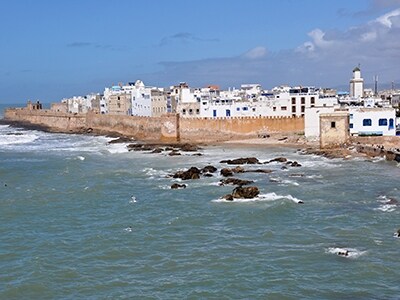
Castle wall that protects the medina and houses of white walls
In North Africa there are several cities known for their beautiful houses of white walls and blue walls. One example is the "Blue City" Shawen (Morocco), "Paris of North Africa" Algiers (Algeria), "Small Paradise of White and Blue" Sidi Bou Said (Tunisia), but especially Moroccans and Spaniards, France Essaouira is the most popular city for people.
Essaouira's Old Town called "Medina" is a peninsular land projecting in the Atlantic Ocean, surrounded by blue sea and blue sky throughout the year from a warm and dry climate. The white-walled houses built there are like pearls caught in a blue shell. One point blue coloring door and window frame draws beautiful contrast.
Each street in such a city is unique. Not only is it separated by industries, such as selling carpets, as well as street selling condiments, it is unified with a single line of purple, a gorgeous illustration is drawn, etc. It is directed artistically respectively. It's a very pleasant city just by being lost and walking.
So I do not know if the artists will be gathered or attractive because the artists gather, but have been fascinated by many artists since ancient times, especially loved by musicians such as Bob Marley, Jimi Hendrix, Led Zeppelin, and Cat Stevens It was.
Actually Essaouira is also known as "the city of music". A variety of Arab and West African music are being played, but music that is particularly popular is Gnawa. Stringed instruments Genburi and percussion instruments Carcabet, ethnic music that repeats a minimalist rhythm using human voice, is not only enjoyed listening to the performance and dancing, it is also transmitted as religious music leading music therapy and people to the state of trance . The spectators from all over the world come to the Gona Festival to be held in Essaouira from June to July.

The houses of Essaouira colored with blue and white. This is outside the Medina. The color of the carriage is unified


Cowardly housewares and walls are very artistic
Castle wall that protects the medina and houses of white walls
In North Africa there are several cities known for their beautiful houses of white walls and blue walls. One example is the "Blue City" Shawen (Morocco), "Paris of North Africa" Algiers (Algeria), "Small Paradise of White and Blue" Sidi Bou Said (Tunisia), but especially Moroccans and Spaniards, France Essaouira is the most popular city for people.
Essaouira's Old Town called "Medina" is a peninsular land projecting in the Atlantic Ocean, surrounded by blue sea and blue sky throughout the year from a warm and dry climate. The white-walled houses built there are like pearls caught in a blue shell. One point blue coloring door and window frame draws beautiful contrast.
Essaouira's Old Town called "Medina" is a peninsular land projecting in the Atlantic Ocean, surrounded by blue sea and blue sky throughout the year from a warm and dry climate. The white-walled houses built there are like pearls caught in a blue shell. One point blue coloring door and window frame draws beautiful contrast.
Each street in such a city is unique. Not only is it separated by industries, such as selling carpets, as well as street selling condiments, it is unified with a single line of purple, a gorgeous illustration is drawn, etc. It is directed artistically respectively. It's a very pleasant city just by being lost and walking.
So I do not know if the artists will be gathered or attractive because the artists gather, but have been fascinated by many artists since ancient times, especially loved by musicians such as Bob Marley, Jimi Hendrix, Led Zeppelin, and Cat Stevens It was.
Actually Essaouira is also known as "the city of music". A variety of Arab and West African music are being played, but music that is particularly popular is Gnawa. Stringed instruments Genburi and percussion instruments Carcabet, ethnic music that repeats a minimalist rhythm using human voice, is not only enjoyed listening to the performance and dancing, it is also transmitted as religious music leading music therapy and people to the state of trance . The spectators from all over the world come to the Gona Festival to be held in Essaouira from June to July.
So I do not know if the artists will be gathered or attractive because the artists gather, but have been fascinated by many artists since ancient times, especially loved by musicians such as Bob Marley, Jimi Hendrix, Led Zeppelin, and Cat Stevens It was.
Actually Essaouira is also known as "the city of music". A variety of Arab and West African music are being played, but music that is particularly popular is Gnawa. Stringed instruments Genburi and percussion instruments Carcabet, ethnic music that repeats a minimalist rhythm using human voice, is not only enjoyed listening to the performance and dancing, it is also transmitted as religious music leading music therapy and people to the state of trance . The spectators from all over the world come to the Gona Festival to be held in Essaouira from June to July.
The houses of Essaouira colored with blue and white. This is outside the Medina. The color of the carriage is unified
Cowardly housewares and walls are very artistic
Exotic fortified city

Every single street is thus very unique. The wall is the wall
Essaouira is a truly artistic city, but when you are walking down the street there are sturdy walls and grand cannons.
Actually, this town is based on the fort built by Portugal in the 15th century, and in the 18th century it was surrounded by gullies in the walls and developed as a fortified city. The wall is the state-of-the-art style at the time called the Vauban style which was prevalent in France. It is characterized by a ledge called ridge bridge, but it can be confirmed with a northern ridge with an observatory and a rounded south ridge.
While the walls, gates, palaces, government offices and the like are stone-made in Western style, mosques and madrasas (higher education institutions attached to mosques) are Arab style in North Africa. The dense houses and small windows also show the influence of the castle fortress of the Berber people of West African nomads called Caspa. This multicultural fusion creates exotic streets unparalleled.
Actually, this town is based on the fort built by Portugal in the 15th century, and in the 18th century it was surrounded by gullies in the walls and developed as a fortified city. The wall is the state-of-the-art style at the time called the Vauban style which was prevalent in France. It is characterized by a ledge called ridge bridge, but it can be confirmed with a northern ridge with an observatory and a rounded south ridge.
While the walls, gates, palaces, government offices and the like are stone-made in Western style, mosques and madrasas (higher education institutions attached to mosques) are Arab style in North Africa. The dense houses and small windows also show the influence of the castle fortress of the Berber people of West African nomads called Caspa. This multicultural fusion creates exotic streets unparalleled.
Cultural diversity is also shown in dishes and the like. Boasting a variety of ingredients like seashores from fish and shellfishes to vegetables and fruits, while enjoying the taste of the material itself with a cooked recipe like Mediterranean cuisine, cooking methods in the desert region including Tazine hotpot are also transmitted , Steamed vegetables and boiled dishes are well developed.
And the walls made a big contribution to protecting these unique cultures. In addition to protecting the Medina from European strength and bandits attacks, we also protected the cityscape from modernization due to its inconvenience.
And the walls made a big contribution to protecting these unique cultures. In addition to protecting the Medina from European strength and bandits attacks, we also protected the cityscape from modernization due to its inconvenience.

Cannon provided at the wall

Rich marine products
History of Essaouira 1. The birth of Mogador

Istiklal street crowded with locals. The hooded costume worn by the right woman is called Jerava
Let's try to understand why such multicultural convergence city was born.
It is known that Essaouira flourished as one of the trade ports of Phoenicians who played the role of Mediterranean trade around the 7th century BC. After that, many countries including the Roman Empire made use of this port as a trade base.
Essaouira will make a leap forward since the 16th century. In 1506, Portuguese king Manuel I built a fort here, south of the Atlantic Ocean and developed as a base for Portuguese aiming for West Africa and India. Around this time, the city was called "Mogador".
The Sahara Desert is spreading in the southwestern part of Morocco, but the Berber people were prosperous in the caravan trade crossing the desert. The Berbers trade with the "golden capital" Tombuktu, Moroccan cities such as Marrakesh and Essaouira. Portugal exported such gold, sugar, molasses, ivory, slave, etc. to home country.
Essaouira will make a leap forward since the 16th century. In 1506, Portuguese king Manuel I built a fort here, south of the Atlantic Ocean and developed as a base for Portuguese aiming for West Africa and India. Around this time, the city was called "Mogador".
The Sahara Desert is spreading in the southwestern part of Morocco, but the Berber people were prosperous in the caravan trade crossing the desert. The Berbers trade with the "golden capital" Tombuktu, Moroccan cities such as Marrakesh and Essaouira. Portugal exported such gold, sugar, molasses, ivory, slave, etc. to home country.

Harbor ridge and sea gate
History of Essaouira 2. Construction of Essaouira

A fishing boat unified in blue. The walls and ramps that can be seen in the back
In 1660, the Moroccan Kingdom happened to have an Araui morning. King Muhammad III developed Mogador as a port of trade base with Europe from 1765 and asked the French architect Theodor Cluju to build a new city.
Cluju surrounds the city with a straight walled wall and arranges a ridge at each corner to build a castle called the Vauban style (star-shaped castle). With this, the city was renamed Essaouira which means "beautiful design".
After that, in the Alawi morning, taking the policy of isolation, Essaouira was opened as the sole trade port, prospering as a trade base with Europe and the new continent. But when Tangier opened in 1800 and takes over its role, the center of Morocco will move to the northern cities such as Tangier, Rabat and Fes and Essaouira 's prosperity will end.
From around the 16th century Morocco often underwent invasion of European powers and was dominated by countries such as Portugal, France, Spain and the United Kingdom. Essaouira was also suffering from such damage, but such a complex history built up this cultural city.
After that, in the Alawi morning, taking the policy of isolation, Essaouira was opened as the sole trade port, prospering as a trade base with Europe and the new continent. But when Tangier opened in 1800 and takes over its role, the center of Morocco will move to the northern cities such as Tangier, Rabat and Fes and Essaouira 's prosperity will end.
From around the 16th century Morocco often underwent invasion of European powers and was dominated by countries such as Portugal, France, Spain and the United Kingdom. Essaouira was also suffering from such damage, but such a complex history built up this cultural city.

Istiklal Street. The left tower is a minaret next to the mosque
A view of the World Heritage "Medina of Essaouira"

Beautiful house with white walls
Essaouira is an attraction of the entire Medina, and each street is full of charm. I'd like to enjoy the charm with doubt, but there are also some prominent buildings, so I will briefly explain it.
■ Citadel (scala)
Many of the walls surrounding the city were built in the 18th century, Mohammed King III of Morocco. The protrusion which is characteristic of the Vauban type is seen in the northern tip, the south entrance, the ridge of the harbor, and so on. However, the Essaouira citadel does not become a symmetrical shape like a star shape or a regular polygon. In the gate entering the medina, clockwise from the north there are the Dukara gate, the Marrakesh gate, the Subaia gate, the sea gate, and the baffle gate.
■ Government marks
the 18th century, Essaouira has prospered as the only trading port of the Kingdom of Morocco to do the seclusion, the Netherlands and Portugal, the United Kingdom, the consulate, such as France had been installed. The consular official marks of these countries are left. Also, in the island floating in the east of the city you can see prison marks.
■ Jewish Street (Meller)
When the Reconquista (Christian rebirth movement) got intense at the Iberian Peninsula, the Jews also fled to North Africa with Muslims. In the northeastern part of the Medina there is a Jewish city built by such Jews, with the remains of joint cemetery and synagogues (place of worship). Many Jews left this land following the founding of Israel after the Second World War, and the town was abandoned.
■ religious facility
Essaouira was also the fusion city of multi-religion. Apart from Islamic facilities including the Grand Mosque and Ben Youssef Madrasa, the Portuguese church built in the 18th century and the remains of the Simon Atias and Synagogue that was built in the 19th century are left. Azan (call of worship) which flows 5 times a day from the tower adjacent to the mosque = minaret is also impressive.
■ Souk (market)
In addition to a fish market adjacent to the fishing port, there is a market for each type of industry, such as spices of soy, jewelry souks, ingredients souks, clothing souks and industries. There are stalls for tourists selling paintings, sculptures, ceramics and the like to various places on the street besides these.
■ fishing port
and a number of fishing boats is staying, it has been the hotel's well as shipyard. A fisherman who arranged fish can catch a cat with a cat and gulls and enjoy a warm scenery around. In the north of the harbor is a restaurant dotted with seafood and a sandy beach spreads to the south.
■ Riyadh
Riyadh shows a private house with a courtyard, in Morocco is called Riyadh the old house hotel, which was renovated traditional houses. It is a great appeal to have a tasteful appearance, courtyards filled with flowers, old-fashioned fireplaces, as well as contact with the owner's family.
■ Citadel (scala)
Many of the walls surrounding the city were built in the 18th century, Mohammed King III of Morocco. The protrusion which is characteristic of the Vauban type is seen in the northern tip, the south entrance, the ridge of the harbor, and so on. However, the Essaouira citadel does not become a symmetrical shape like a star shape or a regular polygon. In the gate entering the medina, clockwise from the north there are the Dukara gate, the Marrakesh gate, the Subaia gate, the sea gate, and the baffle gate.
■ Government marks
the 18th century, Essaouira has prospered as the only trading port of the Kingdom of Morocco to do the seclusion, the Netherlands and Portugal, the United Kingdom, the consulate, such as France had been installed. The consular official marks of these countries are left. Also, in the island floating in the east of the city you can see prison marks.
■ Jewish Street (Meller)
When the Reconquista (Christian rebirth movement) got intense at the Iberian Peninsula, the Jews also fled to North Africa with Muslims. In the northeastern part of the Medina there is a Jewish city built by such Jews, with the remains of joint cemetery and synagogues (place of worship). Many Jews left this land following the founding of Israel after the Second World War, and the town was abandoned.
■ religious facility
Essaouira was also the fusion city of multi-religion. Apart from Islamic facilities including the Grand Mosque and Ben Youssef Madrasa, the Portuguese church built in the 18th century and the remains of the Simon Atias and Synagogue that was built in the 19th century are left. Azan (call of worship) which flows 5 times a day from the tower adjacent to the mosque = minaret is also impressive.
■ Souk (market)
In addition to a fish market adjacent to the fishing port, there is a market for each type of industry, such as spices of soy, jewelry souks, ingredients souks, clothing souks and industries. There are stalls for tourists selling paintings, sculptures, ceramics and the like to various places on the street besides these.
■ fishing port
and a number of fishing boats is staying, it has been the hotel's well as shipyard. A fisherman who arranged fish can catch a cat with a cat and gulls and enjoy a warm scenery around. In the north of the harbor is a restaurant dotted with seafood and a sandy beach spreads to the south.
■ Riyadh
Riyadh shows a private house with a courtyard, in Morocco is called Riyadh the old house hotel, which was renovated traditional houses. It is a great appeal to have a tasteful appearance, courtyards filled with flowers, old-fashioned fireplaces, as well as contact with the owner's family.

There are stalls selling carpets in this neighborhood

A ramp of the north. It is surrounded by double walled walls for enemy shells
The way to Essaouira

The clock tower becoming the landmark of Essaouira
■ Air & Tour Information
Since there is no direct flight from Japan to Morocco, it passes through European cities such as Paris and other Asian cities such as Dubai. Many people enter Rabat, Casablanca, Marrakech, Fes, but Essaouira also has an airport. About 150,000 yen for cheap airline tickets and around 200,000 yen for tours.
■ World Heritage Sites around
the world heritage "in Essaouira Higashiyaku 170km Marrakech old town there is" a large number of the bus is back and forth. Because it is about 3 to 4 hours one way, day trip is also possible. From Marrakech " Ait Ben Haddou settlements such as" and Meruzuka, have come up with a number of tours in the desert area.
230 km northeast of Essaouira is "Portuguese city of Masagan [Al Jazida]".
People entering the Rabat is: It is the "Rabat modern city and the historic city is the capital to co-exist", people entering the Fez " Fez the Old Town in addition there is a", "the ancient ruins of Volubilis," "Historic City of Meknes" and also far away Absent.
■ World Heritage Sites around
the world heritage "in Essaouira Higashiyaku 170km Marrakech old town there is" a large number of the bus is back and forth. Because it is about 3 to 4 hours one way, day trip is also possible. From Marrakech " Ait Ben Haddou settlements such as" and Meruzuka, have come up with a number of tours in the desert area.
230 km northeast of Essaouira is "Portuguese city of Masagan [Al Jazida]".
People entering the Rabat is: It is the "Rabat modern city and the historic city is the capital to co-exist", people entering the Fez " Fez the Old Town in addition there is a", "the ancient ruins of Volubilis," "Historic City of Meknes" and also far away Absent.
Best season of Essaouira


Look at the wall from the northern ridge. You can see the cannon lining along the coast
Essaouira's temperature does not change greatly throughout the year, and it is stable in the warmest August-September with average high temperature of 21 degrees, average lowest temperature of 18 degrees, the coldest January to March in 17 degrees and 12 degrees ing.
There is little rain, and it rains hardly especially in May - September. The rainy weather is high from November to December, but still the lowest rainfall in Tokyo is around 12 to 1 month.
People who visit the desert in Morocco have a temperature difference of 20 degrees or more in summer and winter and the temperature difference in the day is also great, so it would be better to match that season.
There is little rain, and it rains hardly especially in May - September. The rainy weather is high from November to December, but still the lowest rainfall in Tokyo is around 12 to 1 month.
People who visit the desert in Morocco have a temperature difference of 20 degrees or more in summer and winter and the temperature difference in the day is also great, so it would be better to match that season.

Dukara gate which is the entrance to the medina


0 comments:
Post a Comment